Sunday, March 23, 2008

Some Relief at the Water's Edge

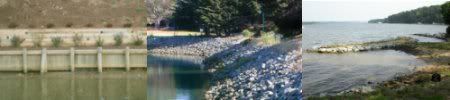
Looks like the General Assembly is poised to grant some much needed relief to our weary shorelines. Rather than continue to allow the rocking (and to a lesser extent, bulkheading) of our shorelines, the new law, requested by MDE, would require shoreline stabilization take the form of "living shorelines", unless "a property owner could prove erosion is so severe that only an armored shoreline will do."

That's great news for the Bay, even though hundreds of miles of of its periphery have already been hardened. Looks like a number of strong environmental bills are going to come out of the 2008 session. I will re-cap them here after the Assembly adjourns.


From L to R: Wooden Bulkhead, Stone Rip Rap, Headland Breakwater with Living Shoreline

Labels: , ,

Tuesday, January 29, 2008

Get Back to Where You Once Belonged

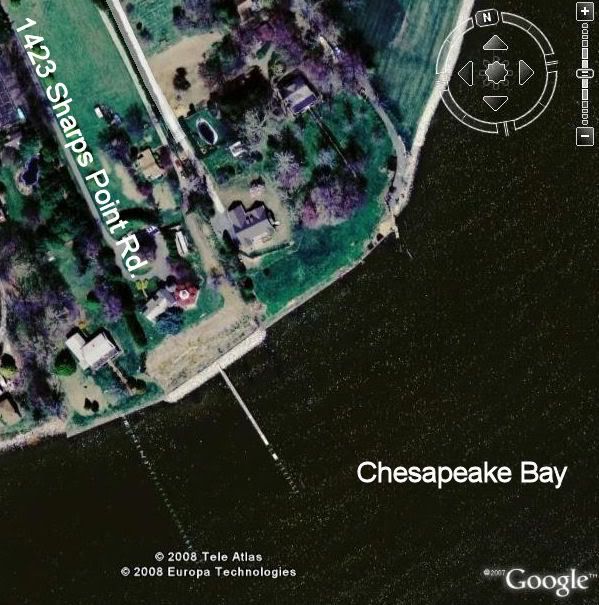
It was a little over 2 years ago that it was reported that a St. Margaret's couple had filled in a 1/4 acre of Bay under the guise of reclaiming land lost by Hurricane Isabel.

Today, we get the good news from the Capital that all that fill will be coming out, thanks to a court order. In addition, the couple and their engineering firm, The Permit Coordinators, were fined $50,000 for the violations. The material removal is slated to be completed by the end of March, lest additional fines begin to mount. The aerial image below makes the infraction, and the once non-permitted lighthouse B&B (in red), pretty clear.


14234 Sharp's Point Road

Who knows, perhaps in 2 more years we'll be celebrating the removal of 40 truckloads of garbage from Judge Gatewood's property.

Labels:

Sunday, January 20, 2008

The Great Glenwood Gorge

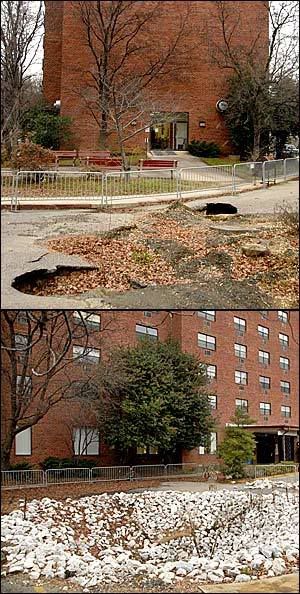
For three years, the sinkholes in front of the Glenwood Apartments, located off Clay Street in Annapolis, have been expanding. And, for three years, the Annapolis Housing Authority, who owns the property, and the City of Annapolis have dawdled on how to handle the situation.

Below are photos of the site from the Capital.


Photo by J. Henson

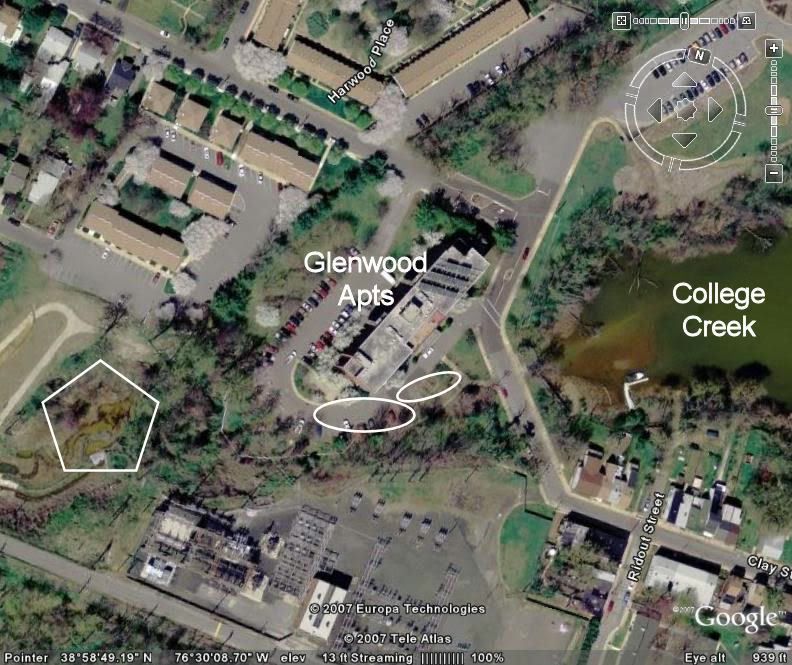
The City Administrator and acting director of Public Works, Bob Agee, said after his employees went out to the sinkholes last year, they couldn't devise how to stop it, or what was even causing it. Here's a hint courtesy Google Earth:


To the right is College Creek. In the center are the Glenwood Apartments, with the location of the sinkholes marked with ovals. To the left, marked roughly by the pentagon, are the headwaters of College Creek. Notice how they disappear between this point and the Creek? That's because they have almost certainly been piped under the fill that forms the foundation for the parking lot on that side of Glenwood. Chances are, the pipes have failed, the soil is washing out into College Creek, and the land is subsiding. Viola, sinkholes!

So what is this right way to fix this mess? How about "daylighting" the stream [pdf]? Pulling out the fill, peeling back the stream banks, and restoring the waterway will mean losing some parking (most of which has been lost for the past three years), and may mean placing a bridge or large culvert where Clay Street crosses it, but, it will arrest the degradation, prevent the additional siltation of College Creek, and be an amenity for the residents of Glenwood.

Let's hope the parties involved get their act together before damage to the foundation of the apartment complex does occur.

Labels: ,

Thursday, December 27, 2007

Treating Oysters Like Royalty

Today's Capital reports that a local inventor, Andrew Murdza, has devised a new way to raise oysters to help replenish the Bay's decimated bivalve population. Murdza founded Oyster King several years ago and established a base of operations at Discovery Village in Shady Side.

He is now selling "Oyster Hotels", cages filled with barley straw to help filter contaminants, to house oyster spat and protect them from predators.

Mr. Murdza's initial tests have yielded excellent short term (6 month) survivability and he looks forward to eventually spawning 50 million baby oysters to help re-stock the Bay. His method of growing oysters at the water's surface mimics the well-documented accounts of European settlers who first came upon the Bay. For instance, when Captain John Smith explored the Bay in the early 1600s, oyster reefs broke the water's surface and were often deemed "hazards to navigation." One is left to contemplate not only the role that these massive reefs historically played in oyster propagation, but also in protecting the shoreline from high wave energies.

Curiously, the cost of the Oyster Hotels is $500 apiece, which corresponds exactly to the upper limit the State will reimburse homeowners for placing oyster aquaculture floats on their property. Oyster gardening supplies can be purchased from a wide variety of suppliers. A partial listing can be found here.

Labels: , ,

Wednesday, December 26, 2007

Bay Clean-Up Estimates Too Optimistic, If You Can Believe It

A recent analysis of Bay pollution reduction models by the Chesapeake Bay Program (CBP) found that half (18) over-estimated progress, most of the rest (15) were accurate, and a few more (3) under-estimated progress. I suspect this isn't much of a surprise to anyone who has spent any prolonged length of time around the Bay in the last decade or so. Despite undeniable and important advances (e.g, the flush fee), the region continues to grow astronomically, with ever-changing consequences.

The Program models seem to be relatively accurate in the case of point source pollution (e.g., sewage treatment plants), where a discrete discharge can be easily measured, but pollution from non-point sources, like farm fields, or septic systems is difficult to accurately gauge. In those instances, data from case studies has to be extrapolated to a much wider set of circumstances, and errors in the case study, or the appropriateness of the wider application, can skew the results wildly.

To reduce the margin of error in the models, CBP is doing experimental work on a number of pollution controls and best management practices. That data should be available by the end of 2008.

Labels: , ,

Saturday, December 22, 2007

Flush Fee In Action II

When the Bay Restoration Fund (aka The Flush Fee) was passed in 2004 by the Legislature and signed into law by Governor Ehrlich, there was great hope for the impact it would have. Several years on, we are now seeing the results of its implementation.

Today's Capital discusses the progress that has been made as a result of the $30/year/home fee on wastewater. All of the Anne Arundel County wastewater treatment plants are slated to be upgraded to "ehanced nutrient removal", at least in part with the assistance of flush fee funds, by 2011. According to the Capital report, some $111,760,000 from the flush will be spent in Anne Arundel County on the collective treatment plant upgrades.

There is also flush fee grant money available through the Anne Arundel County Health Department for upgrading septic systems. Sadly, only about 50 homeowners in the County have taken advantage of the program so far.

Regardless, the program seems to be working well. According to MDE estimates, the current upgrades have led to an annual reduction of nearly 700,000 pounds of nitrogen and nearly 80,000 pounds of phosphorus, and it's estimated that nitrogen will be reduced by 7.5 million pounds per year once all the plants are upgraded.

The success of this model reinforces the notion that in order for infrastructure upgrades to get the funding and attention they deserve, they need a dedicated funding source with an ongoing revenue stream. Counting on politicians to fund maintenance, whether it be for wastewater or stormwater, through the general fund, is pollyannaism at its highest.

* Added Bonus: 6 Common 'Flush Fee' Myths - From CBF

Labels: , ,

Monday, January 29, 2007

County Promotes Innovative Stormwater Techniques

As is the case with so much of the good environmental work that comes out of County government, the Department of Public Works recently hosted a series of seminars on innovative stormwater management techniques. Given that Anne Arundel County has something on the order of $500 million in its maintenance and restoration backlog, it needs to be requiring best practices on all future projects.

Labels: ,

Thursday, August 31, 2006

Flush Fee In Action

The Board of Public Works recently approved grants totaling $18.6 million for planning and design of improvements to the Patapsco and Back River plants. The plants are two of the most active in processing sewage for the Baltimore metro region, and the proposed upgrades will help prevent 7.5 million pounds nitrogen from entering the Bay annually. The funds for the projects will come from the $76 million already collected by the $30/year fee.

Labels:

Thursday, August 10, 2006

Restoring Our Waterways

Today's Post has good piece explaining the proposed Anne Arundel County Watershed Restoration Fund. In this election year, support for the fund, which would raise $36 million a year for the dedicated purpose of stream restoration and storm drainage projects is the local environmental issue facing county executive and county council candidates, as well the public-at-large.

The County is currently spending about $9 million a year on the maintenance and creation of stormwater infrastructure, and it still has a several hundred million dollar backlog. As with school maintenance, if we ever hope to get out of the hole that we're digging, we need to get serious about funding our ongoing needs. The current Council and Executive, with the exception of Pam Beidle (District 1) and Barbara Samorajczyk (District 6) have failed to exercise the leadership necessary to make these improvements occur. Let's hope the next Executive and Council don't show the same lack of will.

As of this post, only one County Executive candidate, George Johnson, has come out fully in support of the fund. Several County Council candidates, including Rik Forgo (District 1), Jamie Benoit (District 4), Devin Tucker (District 4), A.J. "Tito" Baca (District 5), Josh Cohen (District 6), Phil Dales (District 6), and Robert Tufts (District 7) have come out in support of the $5/month fee [If there are others, please send me an e-mail].

[One correction in the Post piece: The article states, "Businesses would pay a proportionate amount. Coalition leaders are hoping a newly elected council this fall would determine the best way to raise the money. An increase in property tax is one possibility." In fact, a property tax increase is not a possibility, as the tax cap would prevent that from happening. The most likely option is an additional utility fee, like many county residents currently pay for water, wastewater, and trash.]

Labels: ,

Monday, July 31, 2006

A Small Step for the Bay

Some relatively good news for the Chesapeake today, the Capital reports that Maryland and Virginia have come to an agreement to limit the annual harvest of menhaden from the Bay. Of course, in this instance, it isn't the Maryland fishery that's the problem, it's the ravenous Omega Proteins plant based in Reedville, Virginia that is taking the small, oily fish at an unsustainable rate.

The new agreement caps the annual take at 109,000 tons a year (down from the 189,500 ton average annual landings during the 1990s). A coalition called Menhaden Matter was working to halt the fishery, while the state of the menhaden fishery could be studied. If ever there was a tragedy of the commons, surely this is it: A giant corporate behemoth, based in Texas, operating out of Virginia, raids our collective resource, and privatizes the profits 1,500 miles away, while a cascade of bay-area fisheries collapse.

Along these same lines, I hope each of you will take the time to read this bone-chilling series from the Baltimore Sun/LA Times on the decline of our oceans.

Labels: ,

Friday, April 21, 2006

Greening Up Annapolis

Tomorrow, Saturday April 22, marks the 15th Annual Annapolis Greenscape, where local residents plant trees and shrubs provided by the City to beautify Annapolis. Find a site and help out if you're interested.

Labels:

Monday, November 28, 2005

Cleaning Up Our Arteries

This weekend's Washington Post Magazine had a great piece on the efforts of locals citizens to clean up metro area streams. It begins with the account of a golf course whose herbicides poisoned Donaldson Run in Arlington, VA and explains the growth of stream protection efforts over the course of the past decade.

It also discusses, at some length, the increasing problem of impervious surface ("The Chesapeake Bay watershed has enough pavement to park 116 million cars.") and the need to effectively treat stormwater runoff.

One paved acre of land throws off 16 times more water than a one-acre meadow does. Once the impervious rating in a watershed climbs much over 10 to 15 percent, the stream that drains it begins to wash away. When the impervious rating is 55 percent, the variety of stream creatures drops by 90 percent, and sensitive species disappear entirely.

Locally, we've been lucky to have several such restoration projects in the last few years, including one in front of Edgewater Elementary, Howard's Branch in Severna Park, and Wilelinor in Annapolis. The Wilelinor project, the most recently completed of the three, transformed several failing stormwater ponds that had been seeping silt into Church Creek, into one of the most extraordinary feats of engineering I've had the pleasure to witness.

From Route 2 to Church Creek now flows a sinuous, vegetated stream, flanked by several infiltration ponds. Thanks to the efforts of local volunteers, its banks have been planted with native vegetation and shrubs, and Atlantic White Cedars climbing skyward toward the holes in the canopy.


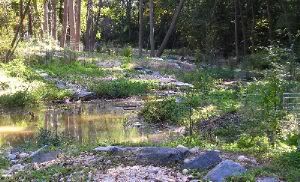
Wilelinor's beautiful new stream


The National River Restoration Science Synthesis Project is working to develop a tool to measure the ultimate effectiveness of such projects.

Labels:

Thursday, November 17, 2005

Better to Bend Like the Reed Than Break Like the Stone

As the field of shoreline protection matures, a fortunate confluence is occurring. It's beginning to look like solutions that are better for the Bay and its wildlife are also better at keeping land from washing into the drink. This month's edition of the Bay Journal discusses the growing popularity of "living shorelines," an approach that "uses strategically placed plants, stone and sand to deflect wave action, conserve soil and simultaneously provide critical shoreline habitat."

Anne Arundel Soil Conservation District Manager Jeff Opel relayed a tale of how different shoreline types weathered Isabel:

"“We flew most of the county shoreline by helicopter shortly before the hurricane hit, and we flew it again about 90 days later. There was really significant damage along walls and bulkheads, and along riprap,"” Opel said. "“But when we looked at where we'’d done nonstructural work, and at wetlands along the main front of the Bay, we saw very little damage to the shoreline itself. We were very surprised. It told us we were on to something."”

Since Isabel, we've seen even more dramatically how the absence of vegetated buffers between water and land can magnify hurricane impacts.

Along with helping to prevent land from sloughing off into the water, living shorelines are a far more accommodating habitat for terrapins, crabs, and fish than either wooden bulkheads, which shear away at any vegetation that may be in front of them, or stone rip-rap, which can cause serious injury to wildlife attempting to climb over it.

Of course, there are also those who argue that erosion is a natural/inevitable process, and that those purchasing waterfront property should go into that decision with their eyes open.

If you're considering a living shoreline for your property, there are several very knowledgeable assets in the community, including Environmental Concern and local river associations like the Severn River Association, South River Federation, and Magothy River Association.


From L to R: Wooden Bulkhead, Stone Rip Rap, Headland Breakwater with Living Shoreline

Labels:

Thursday, October 06, 2005

Personal Responsibility and the Bay

Some folks are moved to protect the Bay because they see the Bay as an end in itself. They believe the Bay and the organisms that inhabit it have their own majesty and deserve the ability to make their way in this world as each one of us does. It would be worth saving even if we were not here.

Others choose to help restore the Bay because of the good that it provides to humans. The Bay's "resources" provide a livelihood for watermen, and sustenance for those of us who partake of its bounty. Its grasses and inhabitants clean the water of pollutants, and the Bay itself is a playground for many area residents. Of course, for many, their motivation is some combination of the two.

Some others, perhaps, don't care much about the Bay one way or another. They argue, that since they don't use the Bay for boating or swimming, or eat crabs and oysters from the Bay, they have no particular obligation to protect, restore, or otherwise "save" the Bay. For these individuals, let me take a page out of the "personal responsibility" playbook.

In this day and age, it's almost impossible to get through a political diatribe without some mention of "personal responsibility". The gist being, "our followers have it, yours don't." Never mind the fact that everyone I've ever discussed the subject with professes to have it. The fact is, we all like to think we are "personally responsible". My hope is, we all are. Part of personal responsibility is limiting the harm that we do to others, and to property which is not ours, to zero. Each and every one of us who owns a home in the Bay watershed, and who allows stormwater to leave our property, and flow onto the property of another, or into community property, is currently harming either our neighbors' property, or the property that we hold in common.

The Stormwater Restoration Fund, that has been mentioned here a number of times is, in essence, an effort to get us to take a share of personal responsibility for the damage we have done by adding impervious surface to the land. Please contact your County Council person and tell them that you would like to see County residents start taking personal responsibility for their property by introducing and passing the stormwater restoration fund.

Labels: ,

Wednesday, February 16, 2005

We Must Destroy the Stream to Save It

On occasion, politicians are accused of being humorless. Let that charge never be leveled against Governor Ehrlich. In an Associated Press piece covered in yesterday's Capital, the Guv said the proposed Inter-County Connector (ICC) "will help replenish choked streams, rebuild wetlands and protect wildlife." The Inter-County Connector, which would effectively be an outer beltway, running through many undeveloped parts of Montgomery and Prince George's counties, has been hailed by its supporters (including Ehrlich, Montgomery Exec. Doug Duncan, and others) as a cure to metro Maryland's traffic congestion problems. Opponents have declared the Inter-County Connector one of the the 27 most wasteful road projects in America, as well as an environmental nightmare.

Whether the Governor's comments were intended to elicit belly laughs from those in attendance at his bus tour of the proposed ICC routes, or he truly believes his doublespeak will fool some people into supporting this project is unclear. What is clear, is that the Governor and others supporting the ICC have consistently overlooked the far more sensible Purple Line Metro extension that would connect metro Maryland suburbs, and avoid the additional traffic congestion associated with more roads.

The proposed $2.4 billion in additional pavement is not what this region or its "streams, wetlands, or wildlife" need. Bob Ehrlich surely must have a sense of humor, problem is, the joke's on us.

More information on the Purple Line.

Labels: , ,